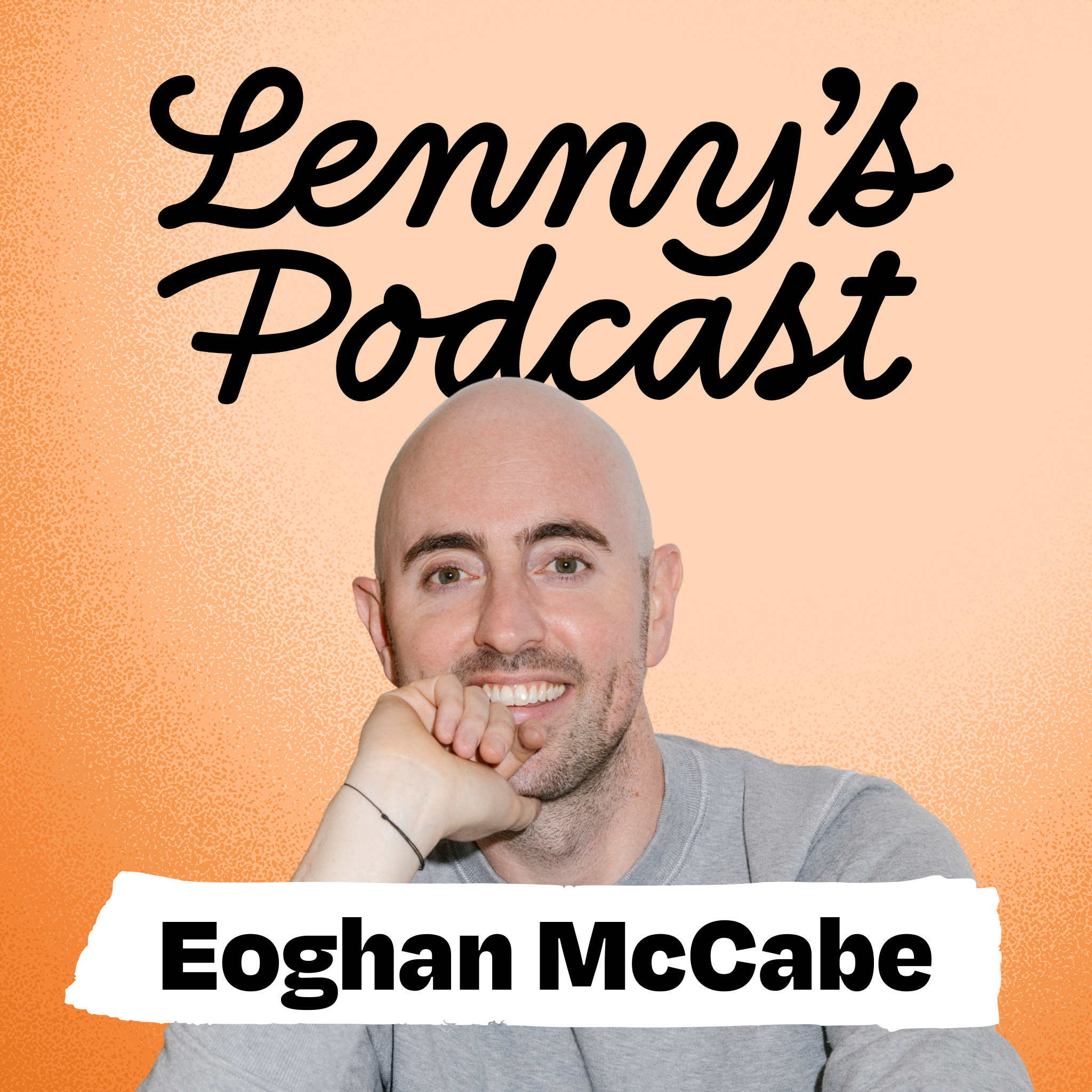
Eoghan McCabe

Eoghan McCabe is the founder and CEO of Intercom, a customer service platform that has successfully pivoted to become an AI-first company with its agent product, Fin. After stepping away from the CEO role in 2020 due to health issues, Eoghan returned to find the company’s growth had stalled. Just one month after his return, ChatGPT launched, and within six weeks, Intercom had a working prototype of what would become Fin.

7 skills 11 insights

AI & Technology Skills

AI disruption is an existential threat that requires aggressive, total commitment rather than incremental adoption.

"You don't have a choice. AI is going to disrupt in the most aggressive violent ways. If you're not in it, you're about to get kicked out of all of it."
00:00

Speed to prototype is critical when a foundational technology shift occurs.

"We were only six weeks into the launch of GPT 3.5 when we actually had a beta version of Fin. I got a text from Des, my co-founder, a week or so after the launch of GPT 3.5 and he said, 'The AI team h..."
11:10

A successful AI pivot requires significant capital allocation and a cultural reset to support high-speed innovation.

"I jumped hard on AI and announced that we were going to spend nearly $100 million of our own cash on that. We allocated a lot of capital, but I also restarted the culture."
28:40

Winning in AI requires adopting the 'vibe coding' and AI-first workflows used by younger, faster startups.

"The younger companies are vibe coding and using AI for their creative work and for their job descriptions... learning to empower and enable them and learn from them too is a really big deal."
54:02

Growth Skills

Outcome-based pricing (charging per resolution) aligns company incentives directly with customer value.

"We charge 99 cents to resolve tickets, customer problems... we wanted our revenue to be 100% aligned with the value that they attained because we had all this scar tissue from pricing prior that felt..."
23:33

Pricing should be determined by the market's willingness to pay for an outcome, assuming technology costs will decrease over time.

"I always believe that that pricing should come from value and not from costs. The cost is our problem. We just had this sense and intuition early on that this thing will get cheaper and it got a lot c..."
25:10

Hiring & Teams Skills

Values should act as a filter to retain only the employees who fit the specific needs of a high-performance or 'wartime' environment.

"I rewrote the values designed to be a sharp knife to cut out the parts of the company that I just knew wouldn't be effective. So, I said that people must be resilient, that we had very high standards,..."
28:40

Culture is enforced through performance management systems that weight values as heavily as output.

"I designed these quarterly performance processes where not only would you get a mark or a grade for your performance against your goals that quarter, but you'd also get a score for your behavior again..."
29:10

Leadership Skills

High-stakes transformation requires a top-down, founder-led decision model rather than a democratic committee approach.

"It is the responsibility of the CEO to make brave and hard decisions unilaterally, yes, using their experts as inputs and be responsible for the outcome. If I make decisions that propel the company in..."
31:50

Product Management Skills

In a pivot, the leader must unilaterally pick a 'lane' to end strategic dilution, even if it is unpopular.

"Strategically we were all over the place and I said, 'We're doing service.' ... It was the type of decision that where I had to practice the professional CEO approach, which is, 'Hey folks, what do yo..."
27:20

Using first-principles frameworks and visual diagrams makes complex strategy teachable and consistent across the org.

"I and we would create frameworks for everything... we'd have really joined up considered strategy... we just love to draw diagrams so you can teach all that stuff."
01:07:36