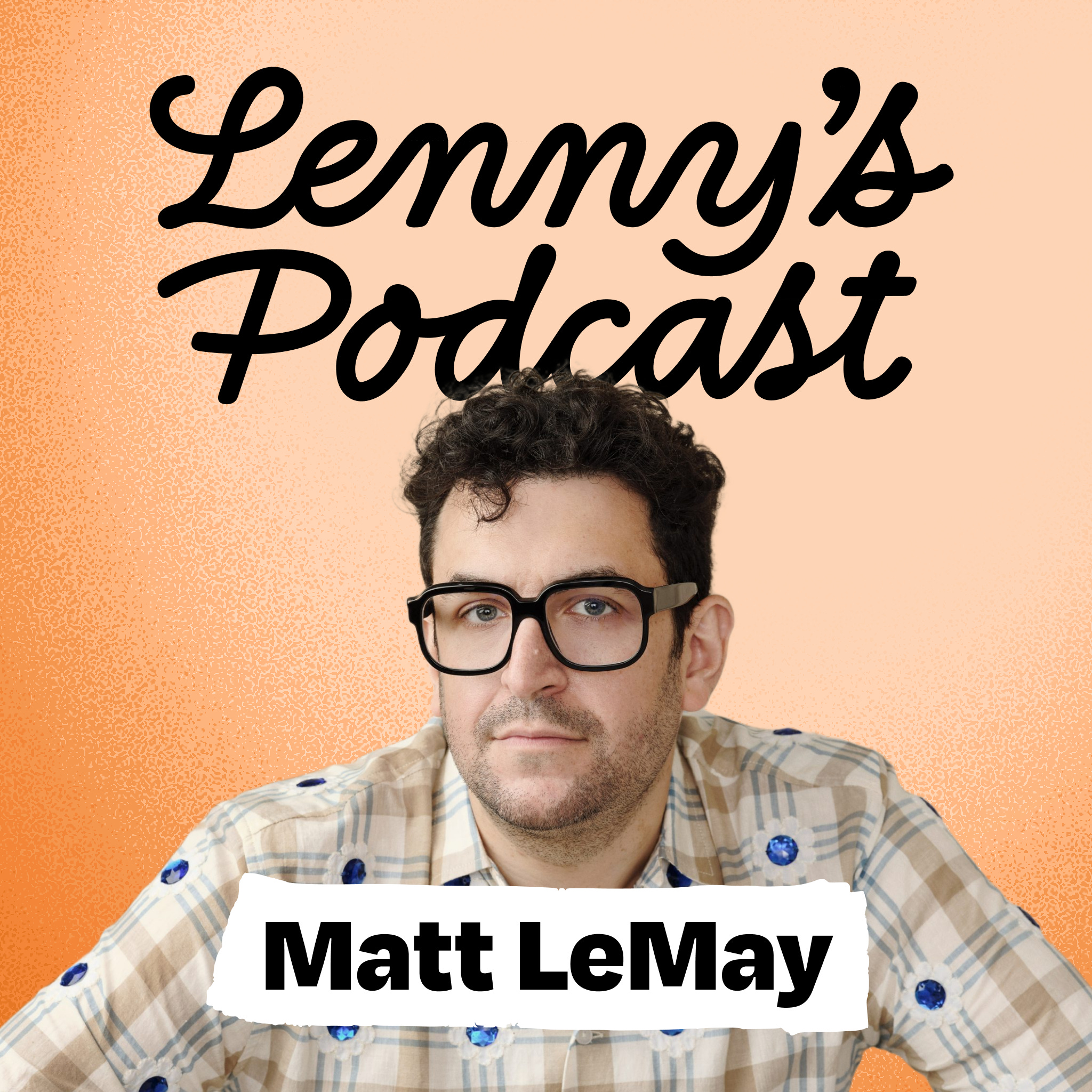
Matt LeMay
Matt LeMay spent 13 years as a music critic at Pitchfork before becoming one of product management’s most influential voices. He’s consulted with companies from startups to Fortune 500s and authored two essential PM books, including Impact-First Product Teams. After watching countless product teams get laid off despite “doing everything right,” he discovered a harsh truth: most PMs are optimizing for the wrong things.
Career Skills
When documenting your career achievements, replace passive language with specific, quantified impact to demonstrate your value to the business.
"I have a friend who does resume coaching, and I showed her my resume a couple of years ago. And she said, 'I love your resume except for one thing. Why do you write like a little girl? Say what you di..."
Communication Skills
Effective stakeholder management involves presenting choices and consequences rather than binary 'yes' or 'no' responses.
"If you're doing product management really well, you never have to say yes and you never have to say no. You're giving people options and you're helping them understand the trade-offs."
Presenting multiple options with a clear recommendation prevents stakeholders from fixating on a single path and encourages constructive trade-off discussions.
"Options and a recommendation is kind of the magic formula... when you present a single option, people's instinct is just to... start poking holes in it... whereas if you come in and say, 'Here are thr..."
Product Management Skills
Teams often prioritize 'safe' low-impact work (like cosmetic features) over 'risky' high-impact work (like core engine improvements), leading to a bloated product that is harder to improve.
"The Low Impact Death Spiral is the dynamic in which every medium to large company I've ever worked with finds itself in one way or another... It starts with adding little features here and there, maki..."
Prioritization frameworks like ICE or RICE are only effective if 'Impact' is measured in the same units as the team's primary business goal.
"Are we estimating and measuring impact in the same unit of measure as our goals? Because if we're doing that, then we're keeping ourselves honest and we're saying, 'Does this actually have a chance of..."
Effective team goals should orbit directly around the primary company goal rather than being buried under multiple layers of organizational cascading.
"So the first is in setting team goals, no more than one step away from company goals. Don't let it get cascaded into oblivion."
High-impact teams start every planning conversation with the top-line target and evaluate all work based on its ability to move that specific needle.
"She stands and she's like, 'Okay, we're going to do things differently.' She steps up to the whiteboard, puts 1 million on the right end of the whiteboard, draws a line, 'This is the year,' draws a li..."
Breaking down a large financial goal against a shipping timeline reveals the true 'impact gap' and forces teams to reconsider their delivery strategy.
"I just put this out on a whiteboard. I'm like, 'All right, a hundred million in profits by the end of the next financial year right now we're here. What else should be on this timeline?' Somebody said..."
Impact is often achieved through subtraction and streamlining rather than adding new features.
"And they did get it done, and they got it done through subtracting. They streamlined the experience. They took out steps that people were getting stuck on. They made things easier. They did the kinds..."