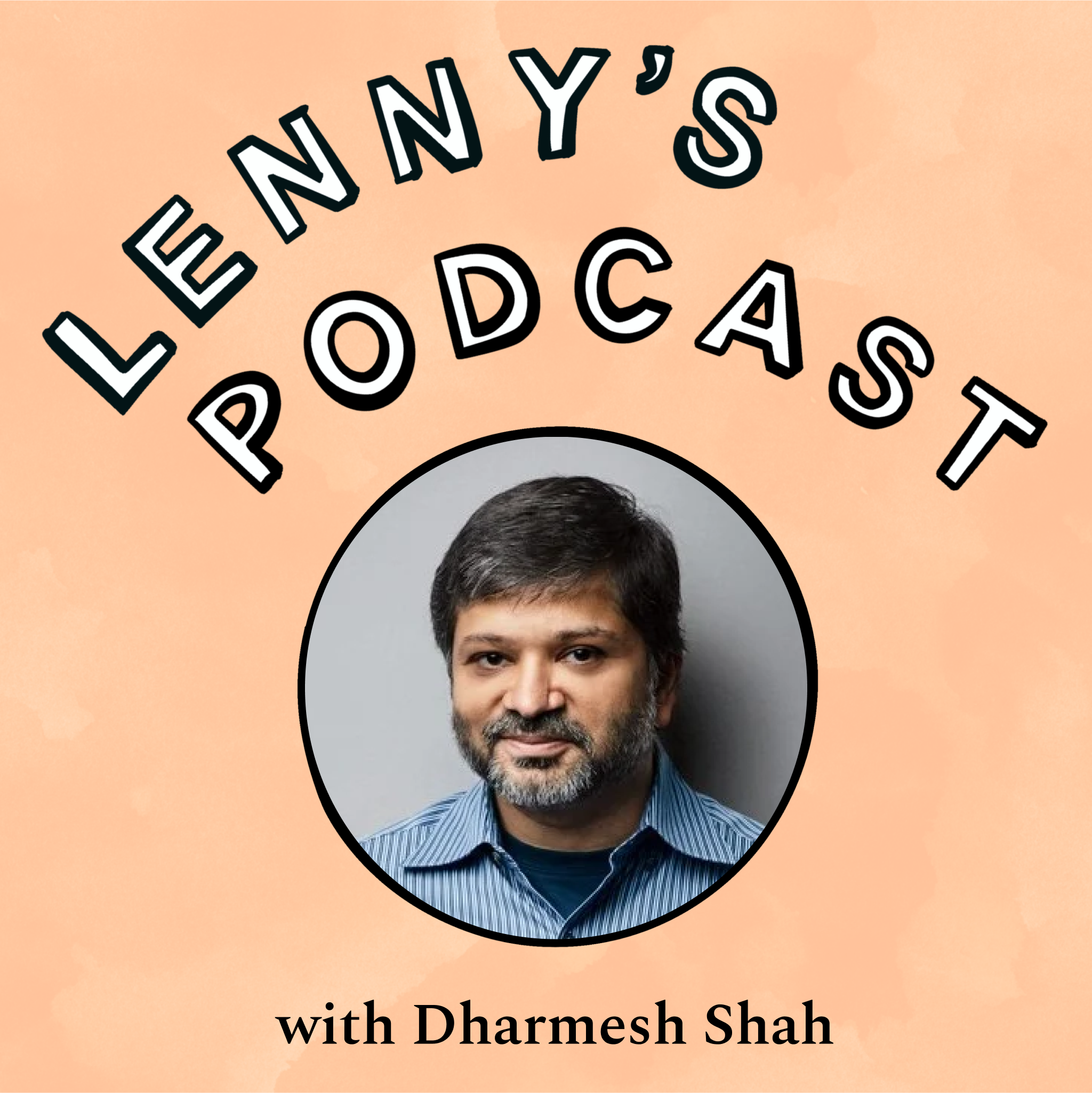
Dharmesh Shah

Dharmesh Shah is the co-founder and CTO of HubSpot (currently valued at $30 billion) and one of the most fascinating founders I’ve ever met. Dharmesh is the keeper of HubSpot’s Culture Code, built ChatSpot (an AI chatbot built on top of HubSpot CRM) and a game called WordPlay (which grew to 16 million users), and also founded and writes for OnStartups, a top-ranking startup blog and community with more than 1M members. He’s also invested in 100+ startups including OpenAI, AngelList, Coinbase, and Dropbox.

9 skills 13 insights

AI & Technology Skills

The core shift in AI product strategy is moving from step-by-step user instructions (clicks/swipes) to outcome-based descriptions (natural language).

"we're going from what was an imperative model... to what engineers would call a declarative model. A declarative model is you describe the outcome you want, not the steps to get there"
01:34:31

Communication Skills

High-stakes public speaking can be improved by quantitatively measuring audience engagement through 'laughs per minute' (LPM).

"I have custom software that I've written that will say, 'Okay, here are the points at which the audience laughed.' Actually audibly laughed. That's the only way it counts. And this actually... and it..."
10:15

Timing and silence are as important as the content when using humor in presentations.

"when you're telling the story, whatever the funny bit is, those have to literally be the last words of that particular segment. So once you deliver it, then you have to stop talking. And the reason yo..."
12:14

Standardized tags in written communication prevent 'founder shadow' where casual suggestions are mistaken for mandates.

"It's the megaphone issue. Someone will pass you in the hall... they'll ask you a question, and as it turns out... people will take that and over-index on what was an opinion... flash tags are literall..."
57:55

Hiring & Teams Skills

Culture is not something you create from scratch but something you articulate and document based on what is already working.

"culture actually already exists. We have a culture. It's like whatever it is, and it's working pretty well... what I'm really trying to do is kind of describe the culture that's there. So it's not cre..."
01:17:32

Treating culture as a product allows you to apply product management principles like user feedback and iteration to the workplace environment.

"culture is a product, period, and that every company builds two products, one is the product they build for their customers, and the other is a product they build for their team. That's what culture i..."
01:21:17

Culture must evolve as the company scales; preserving it exactly as it was in the early days is a mistake.

"the job is to preserve the culture. That is not the job because the needs of your customers change, the needs of the employees change... just like you would never freeze the lines of code of a product..."
01:22:15

Leadership Skills

Extreme delegation involves recognizing that you should not manage people if it is not a core strength, even as a founder.

"I don't want to have any direct reports... I have learned that I suck at management. I'm a reasonably smart person. I think I could become passively okay at management with some training... I don't wa..."
17:04

Decision-making effort should be mathematically proportional to the impact and reversibility of the outcome.

"the calories you spend on a decision should be proportional to the consequences of that decision... He calls them one-way doors versus two-way doors... I'm taking it one level further, which is, it li..."
01:07:21

A successful decision process requires open debate followed by total commitment from all parties, even those who disagreed.

"ours is debate, decide, unite. That's our kind of phrase that we use in HubSpot culture... once you make a decision, getting alignment around that decision... is extremely important"
01:04:42

Product Management Skills

Prioritize by looking at the magnitude of success before the likelihood of success to avoid killing high-impact 'moonshots' too early.

"Start with the potential outcome, then look at probability not the other way around because then you're going to apply that mental filter and throw out ideas that may not have been worth throwing out."
01:11:37

Deeply defining the problem allows you to determine if a broad 'all-in-one' solution is actually necessary versus a single-feature tool.

"one of the mistakes I think founders make is that, especially product oriented founders, is that we fall in love with the solution instead of falling in love with the actual problem"
54:37

To fight product entropy, enforce a 'one-in, one-out' rule for features to keep complexity constant.

"we had a rule in the HubSpot product... that every time you added what we thought of as a knob or dial, called a feature, you had to take one out somewhere else. That's a net amount of... it just at l..."
41:00