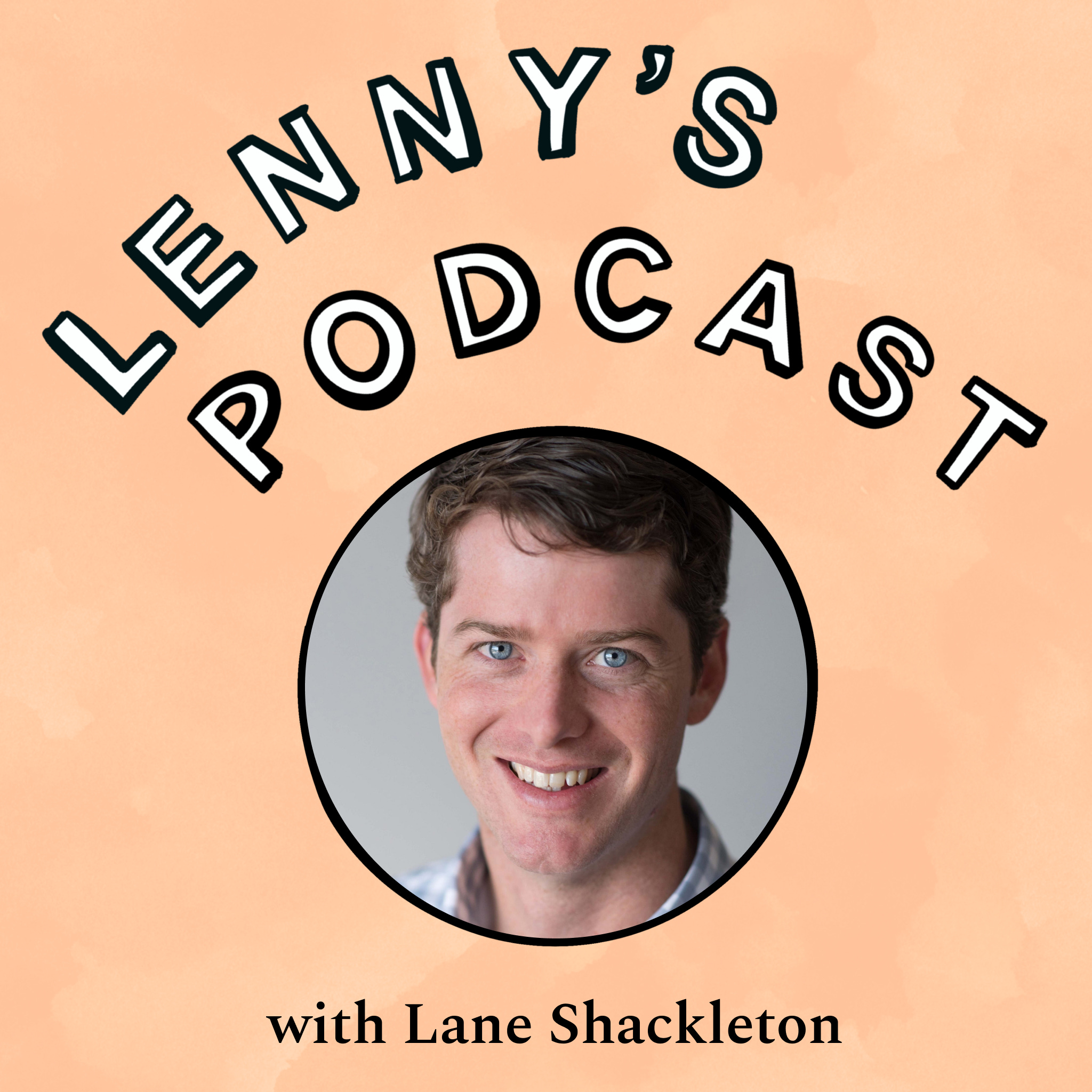
Lane Shackleton

Lane Shackleton is CPO of Coda, where he’s been leading the product and design team for over eight years. Lane started his career as an Alaskan climbing guide and then as a manual reviewer of AdWords ads before becoming a product specialist at Google and later a Group PM at YouTube. He also writes a weekly newsletter with insights and rituals for PMs, product teams, and startups.

12 skills 16 insights

Career Skills

Measure career growth by the frequency of 'oh shit' moments where you feel stretched or underqualified.

"Moments that stretch you or moments that you feel uncomfortable in or you find yourself saying, "Oh shit. I shouldn't be here," or, "I'm under qualified to be here," those are the moments you should b..."
00:00

Communication Skills

Move beyond 'one-way' documents to 'two-way writeups' that integrate feedback, sentiment, and reading status directly into the doc.

"The thesis is that we're in the midst of a new phase, which is essentially two-way writeups and that's where it's more conversational and feedback and discussion is actually part of the content itself..."
01:14:35

Use a 'Catalyst' model to run multi-threaded reviews with dynamic, relevant attendees rather than fixed standing meetings.

"We built Catalyst to really solve those two problems [standing attendees and single-threadedness]. And so the way it works is it's essentially three one hour blocks throughout the week, and the assump..."
44:29

Replace individual project updates in 1:1s with 'Tag-ups' involving the full cross-functional triad to avoid the 'telephone game'.

"The core idea is have a group one-on-one with the key stakeholders... we'll have a tag-up with a small set of people from a given team... and then they meet with their braintrust and it's once a week...."
53:17

Hiring & Teams Skills

Ask candidates to teach you something new to evaluate their communication range and passion.

"One is teach me something that I don't already know. I think it's just an awesome way of seeing if someone's going to lean in and really figure out what you don't know and then how passionate they are..."
01:23:22

Reference checks are a critical skill for evaluating the true performance of a candidate.

"I also recently wrote a post about my favorite ref check question, which I think I would love to learn other people's favorite ref check questions."
01:24:20

Simplify career progression into a few high-bar 'role stages' rather than complex 10-15 level ladders.

"We basically have five levels and we call them role stages and they go from apprentice to principal. So apprentice is ... Rope analogy here is learns about rope. Practitioner is can tie basic knots, s..."
14:19

The guest argues that rituals are the 'engine' of a great team and discusses several specific ones (Catalyst, Dory, Tag-ups, Flash Tags) that go beyond simple meeting management or culture building.

"I think the rituals that I've been writing down are very personal. They're my take on how to do this."

Leadership Skills

Use standardized 'flash tags' to calibrate the weight and urgency of feedback.

"Dharmesh Shah has this ritual from HubSpot called flash tags... It ranges from ... I think it's FYI, suggestion, recommendation, plea. FYI is basically like I had a thought, take it or leave it kind o..."
36:24

Pre-qualify stakeholder involvement in decisions to prevent unnecessary bottlenecks.

"A very simple thing that he did probably in the last six months was he had a table of all the upcoming decisions and then at a tag-up ... he had all the upcoming decisions and then he let people hit a..."
51:30

When faced with high ambiguity, test the 'extremes' immediately to find the upper and lower bounds of a product's potential.

"He just stops and he's like, "You know what? Just test the extremes. Start the experiment tomorrow. We'll figure it out." Essentially. And I think his point was like, look, we can debate this forever...."
59:49

Product Management Skills

Great product leaders ensure every team member understands the 'cathedral' (the vision) rather than just the 'bricks' (tasks).

"The core insight here is that you want your teams to feel like they're building a cathedral and not laying bricks. And I think it's really, really easy to do when PMs are really busy on a day-to-day t..."
25:14

Use '$100 voting' to surface the 'elephant in the room' and quantify team alignment on priorities.

"The ritual is essentially you can take any set of problems or solutions or themes or whatever you want to get people's input on, and you put those into a table and then people can basically vote with..."
48:02

Focus on building 'default-on' systems rather than one-off OKRs to ensure consistent progress.

"Instead of being obsessed with the goal, be obsessed with the system that gets you there. And so the phrase I sometimes use is goals with good intentions don't work. I really need to give a common exa..."
18:34

Separate strategy development from goal-setting to ensure the 'why' isn't lost in the 'what'.

"The first that I end up seeing a lot is just this idea that OKRs are not actually strategy. So I think the way that we plan and the way that our customers plan, the key point is it's critical to disco..."
01:20:30

Limit the time spent on planning to 10% of the total execution window to avoid over-planning.

"The other rule that we live by on the planning side is what we call a 10% planning rule, which is essentially just ensure that you're not for a given time period planning for more than 10% of that exe..."
01:21:06