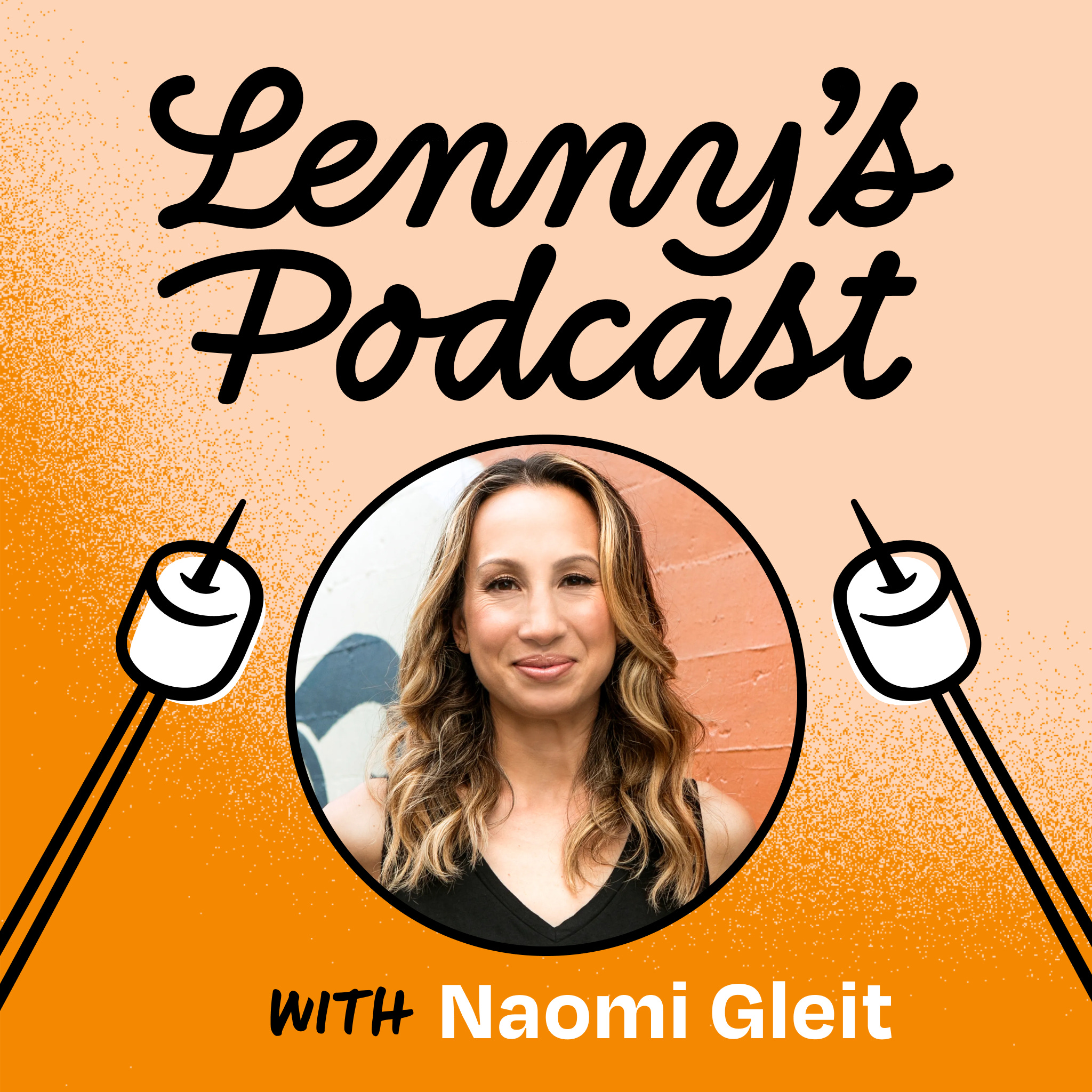
Naomi Gleit

Naomi Gleit is head of product at Meta, joined as employee #29, and is the longest-serving executive at Meta other than Mark Zuckerberg. She’s been at the center of some of the company’s most foundational products, including Facebook’s early growth team.

12 skills 18 insights

Career Skills

To transition into a new role like Product Management, start doing the work informally and voluntarily before applying for the position.

"I sort of took the same approach showing up at the office asking if there were any roles... I had been doing the job voluntarily, almost informally for a few months. And I remember this because I had..."
11:08

Communication Skills

Every project should have a single 'canonical doc' that serves as the central source of truth and links to all other relevant documentation.

"I really believe in frameworks for things that helps drive extreme clarity. I work on a lot of different projects. A lot of times I'm ramping up a new project, I'm like, "Where can I learn what I need..."
00:00

Use numbered lists instead of bullet points to allow for precise referencing during discussions and meetings.

"I never use bulleted lists because you can never refer to a bullet. I always use numbered lists because you can always in the visual in a meeting as referenced in number two, I have feedback on that,..."
52:19

A canonical document must define work streams, single-threaded owners, and the communication processes for the team.

"Everyone should know exactly where the canonical doc is. That's the one place I can go to get all the information I need about a project and it will link to all the other docs... The basic information..."
53:18

Alignment is about shared understanding of facts and trade-offs, not necessarily consensus on the final decision.

"Extreme clarity means everyone's on the same page. It definitely doesn't mean that they all agree with each other, but they just have the same understanding of the facts. So we can disagree, but we al..."
48:57

Establish 'canonical nomenclature' to prevent team members from talking past each other using different terms for the same thing.

"One way to ensure extreme clarity is we have the shared vocabulary... That is what canonical nomenclature is literally writing out all the words in their definitions, so when we communicate, we are us..."
50:07

Separate strategic discussions from operational updates into different meeting formats to maintain focus and efficiency.

"We have one weekly sort of strategic meeting. It's more open-ended, there is time for discussion. It's longer and it's sort of more unstructured. We also have one weekly operational meeting, which is..."
23:25

Use live-editing of visuals during meetings to ensure immediate alignment on decisions and next steps.

"I will often have a visual in a meeting. I will leverage that visual to literally real time edit what is being decided. For example, if we have multiple options, I will edit the slide that's being pro..."
51:54

Effective meetings require pre-reads sent 24 hours in advance and a visual anchor to keep participants focused.

"What I will do is send an agenda 24 hours prior to the meeting. That agenda will include a pre-read... During the meeting... I think it's really important for a group of people to be looking at someth..."
01:07:48

Use the calendar invite as the central hub for all meeting-related communication, including pre-reads and post-meeting notes.

"After the meeting... within 24 hours post-meeting I will send the notes, reply all to the meeting invite and send the notes. So just tactically, I use the calendar invite as the canonical unit by whic..."
01:08:28

Hiring & Teams Skills

High-performing teams need 'disagreeable givers'—people who prioritize the company's interests over being liked and are willing to provide tough feedback.

"The most precious person in an organization is the disagreeable giver. Those are the people who are really motivated to do what's best for the company, but they can be a little bit disagreeable in the..."
21:34

Leadership Skills

Structure decision meetings around a set of three distinct options and a clear recommendation to drive focus.

"Usually a meeting can be and hopefully a meeting is really either is a decision meeting. So if there is a decision, I need three options and I need a recommendation that should hopefully help focus th..."
01:08:28

In high-pressure or uncertain environments, maintain focus strictly on controllable variables and persist relentlessly on those.

"Four life lessons... three, focus on what you can control. And four, for those things never give up."
18:43

Use a 'traffic light' matrix (options vs. criteria) to visualize trade-offs more effectively than a flat list of pros and cons.

"Oftentimes we'll use a traffic light. That means that the three options are three rows. The columns in the table will be criteria by which to evaluate the options... And then obviously it should be co..."
01:09:29

The PM's role is to orchestrate diverse functions to ensure they work in harmony and at the correct tempo without being the 'star' of the show.

"A PM is a conductor. It's as though the team that you are a PM on is an orchestra. There are many different functions in your team that includes legal policy, comms, data analytics, engineering, desig..."
45:52

Product Management Skills

Simplify complex problems by breaking them down into 'kindergarten level' building blocks before adding layers of complexity.

"I often go into a project, everyone's operating at a PhD level, I'm coming in at a kindergarten level... identifying the most basic building blocks of a complex problem and then unfolding, or revealin..."
56:12

Perfect execution is necessary to validate whether a strategy is correct; poor execution leaves the cause of failure ambiguous.

"I want to make sure a project is perfectly executing, because only then can we really reevaluate whether or not this strategy is right or wrong. We're in the worst of all worlds where we are imperfect..."
58:07

The guest discusses the importance of a PM developing a 'first-party perspective' and not outsourcing their thinking to the team or process.

"A PM cannot outsource their perspective or delegate their thinking through people and process."