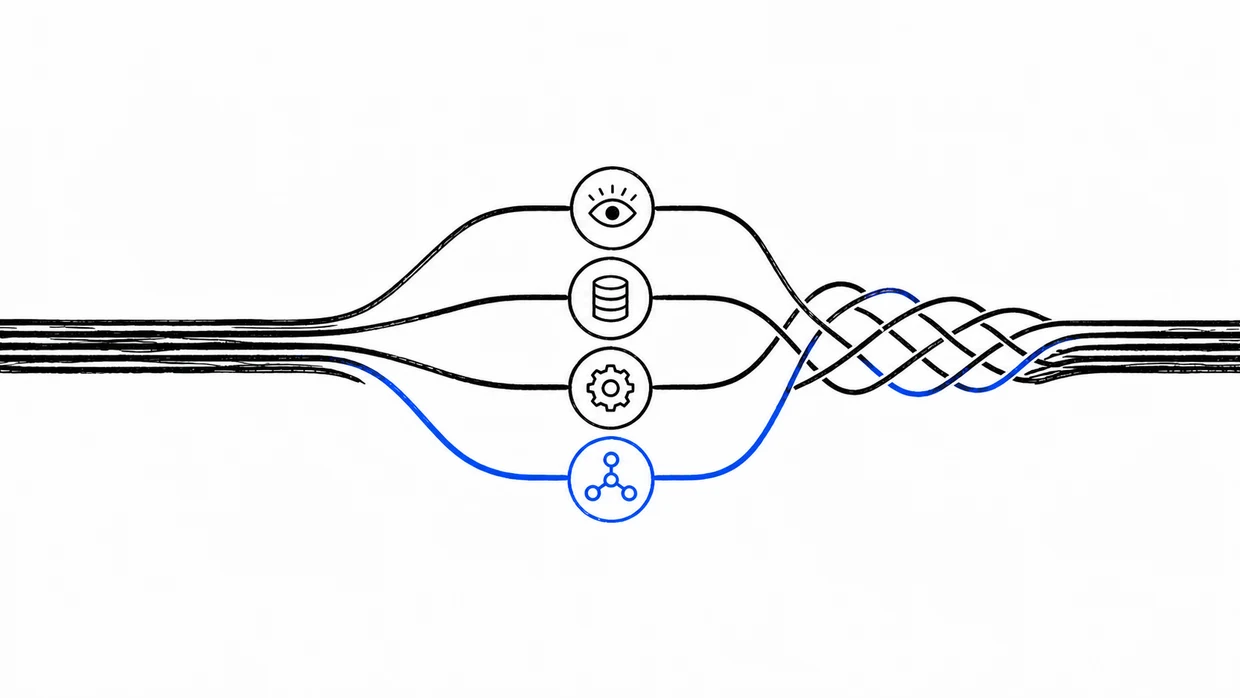
Most companies are adding AI to an operating model designed for humans and software.
They give employees access to ChatGPT. They buy an AI feature for the CRM. They automate a few handoffs. The tools improve, but the company still moves through the same meetings, roles, queues, approvals, and information bottlenecks it had before.
The work remains human-shaped.
That is the limit of tool adoption. It can make individual tasks faster without changing how the business turns an input into an outcome.
An AI operating model starts somewhere else. It takes the work apart, assigns each task to the person, agent, or system best suited to it, and then rebuilds the workflow around that new division of labor.
We call this unbundling and rebundling.
It sounds abstract. In practice, it is a disciplined way to answer five questions:
- What outcome is this part of the business responsible for?
- What work must happen to produce that outcome?
- Which tasks need human judgment, relationships, or accountability?
- Which tasks can an agent prepare, perform, monitor, or coordinate?
- What context, controls, and feedback keep the whole system working?
The model is not an org chart with robot icons added to it. It is a new design for how work moves.
What an Operating Model Actually Is
An operating model describes how a company creates and delivers value.
It connects:
- The outcomes the business is trying to produce
- The workflows that produce those outcomes
- The people and systems responsible for the work
- The information required to make decisions
- The rules governing handoffs and authority
- The metrics used to manage performance
Your org chart shows reporting relationships. Your software architecture shows systems. Neither shows how a customer request becomes delivered work, how information moves between people, or why an approval sits in a queue for four days.
This distinction matters because agents work across those boundaries.
A proposal workflow may touch sales, finance, legal, delivery, a CRM, a call recorder, a document library, and an email inbox. Buying an AI tool for the sales team addresses one box on the org chart. Redesigning the workflow requires seeing the whole chain.
That is why we follow the operating model, not the tool stack or the org chart.
A Job Title Is a Bundle of Tasks
A role is usually 10 to 20 tasks wearing one job title.
Take an account executive. The role may include:
- Researching accounts
- Preparing for calls
- Building relationships
- Running discovery
- Interpreting objections
- Updating CRM records
- Writing follow-ups
- Coordinating internal experts
- Drafting proposals
- Negotiating scope and price
- Forecasting deals
- Managing handoffs to delivery
Those tasks do not require the same capabilities.
Building trust with a buyer, reading political dynamics, and negotiating a complex scope need human judgment and accountability. Gathering account information, formatting call notes, checking CRM completeness, and assembling approved proposal components are different kinds of work.
The old model bundles all of them into one role because a human had to carry the process from start to finish. The new model does not begin with the assumption that the same actor must perform every step.
Unbundling asks what each task actually requires.
Rebundling creates a new role and workflow around the result.
The account executive may spend less time producing documents and maintaining records. The role becomes more concentrated around discovery, relationships, judgment, and commercial decisions. The agent handles preparation and administration. Deterministic software handles validation and system updates. The human remains accountable for the outcome.
The goal is not to preserve every current task. The goal is to preserve and strengthen the valuable human contribution.
The Four Actors in an AI Operating Model
Every task can be assigned to one of four actors.
| Actor | Best suited for | Examples |
|---|---|---|
| Human | Judgment, relationships, persuasion, accountability, novel exceptions | Discovery call, negotiation, performance decision |
| Agent | Ambiguous knowledge work using context and tools | Research brief, first draft, synthesis, triage recommendation |
| Deterministic software | Stable rules, calculations, validation, transactions | Required-field check, tax calculation, permission rule |
| Hybrid | Agent preparation followed by human review or approval | Proposal draft, support response, anomaly investigation |
Companies often assign work to the wrong actor.
They use an agent for a calculation that ordinary code would perform more reliably. They keep a human copying information between systems because the task crosses departmental boundaries. They try to fully automate a judgment that should remain accountable to a person. They ask employees to review every low-risk output even after the system has proven it can handle a narrow case.
Good design is not “use AI wherever possible.” It is intentional assignment.
For each task, ask:
- Does this require interpretation or only a rule?
- Does it require company context?
- Does it require a relationship?
- Is the output reversible?
- Can success be evaluated?
- Who must remain accountable?
The 12-point workflow readiness assessment turns those questions into a practical score before you build.
Map the Business by Value Engine
Do not start the redesign department by department. Start with the engines that create value.
For a service business, we usually map three engines:
- Acquisition: How the company creates demand, qualifies opportunities, and wins work.
- Delivery: How it produces the promised customer outcome.
- Support: How it maintains the relationship, resolves issues, and expands value after delivery.
For a physical-product business, the model usually expands to five:
- Acquisition
- Sourcing
- Production
- Fulfillment
- Support
These engines cut across the org chart.
Customer onboarding may involve sales, operations, finance, delivery, and support. Treating it as a handoff between departments hides the real workflow. Treating it as the first stage of delivery exposes every step required to get the customer to value.
Pick one engine and trace a meaningful outcome from trigger to completion.
Examples:
- Qualified lead to signed agreement
- Signed agreement to successful kickoff
- Purchase order to delivered product
- Support request to verified resolution
- Month-end close to approved management report
This becomes the boundary of the redesign.
Step 1: Define the Outcome and Baseline
Begin with the result, not the agent.
For a client-onboarding workflow, the outcome might be:
A new client reaches a successful kickoff with confirmed scope, owners, access, timeline, and shared understanding within five business days of signature.
Then establish the baseline:
- Current cycle time
- Human hours required
- Number of handoffs
- Error and rework rate
- Customer satisfaction or escalation rate
- Volume per month
- Backlog or delay
Without a baseline, the redesign can become more sophisticated without becoming better.
Use the AI agent ROI framework to separate theoretical time savings from value the business can actually capture.
Step 2: Unbundle the Workflow Into Tasks
Observe the work rather than relying only on the documented process.
The official onboarding process may say:
- Create the client record.
- Gather requirements.
- Schedule kickoff.
The real process may contain 30 steps:
- Search the signed agreement for the final scope
- Confirm which pricing option the client selected
- Find the main contact’s details in the email thread
- Ask sales what they promised verbally
- Copy company information into the project system
- Create a shared folder from a template
- Request system access
- Chase the client for missing information
- Draft a project plan
- Ask delivery to confirm staffing
- Find a kickoff time across six calendars
- Prepare an internal brief
- Prepare a customer-facing agenda
- Send reminders
That hidden work is where the opportunity lives.
For each task, record:
| Field | Question |
|---|---|
| Trigger | What causes this task to begin? |
| Input | What information does it require? |
| Action | What does the person or system do? |
| Decision | Which judgment or rule changes the path? |
| Output | What artifact or state change does it produce? |
| Owner | Who is accountable today? |
| Time | How long does it take? |
| Frequency | How often does it happen? |
| Exception | What causes the happy path to fail? |
| Risk | What happens if it is wrong? |
Do not combine five actions into a box called “process onboarding.” The task map must be detailed enough to assign work intelligently.
Step 3: Assign Each Task to the Right Actor
Now route the tasks.
Consider a proposal workflow:
| Task | Assignment | Why |
|---|---|---|
| Retrieve discovery transcript and account history | Agent | Requires cross-system context gathering |
| Confirm approved rate card version | Deterministic software | One authoritative source and a clear rule |
| Identify stated goals and constraints | Agent, human review | Interpretation is useful; commercial context needs review |
| Choose delivery approach | Human | Requires judgment and accountability |
| Assemble first proposal draft | Agent | Contextual synthesis from approved components |
| Validate required clauses and pricing math | Deterministic software | Rules and calculations should not depend on a model |
| Approve scope and price | Human | Consequential commercial decision |
| Create final document and CRM activity | Software or agent | Structured production and record update |
This table is the heart of the operating model.
It prevents two common mistakes. The first is automating only the obvious drafting step while leaving all the research, retrieval, validation, and system work with the human. The second is giving the agent authority over decisions that require a named person.
Step 4: Redesign the Handoffs
Most operational delay lives between tasks, not inside them.
A person finishes a call. Someone else waits for notes. Finance waits for pricing details. Delivery waits for a scope. The client waits for everyone.
An agent can remove handoffs by carrying context forward.
The transcript becomes structured discovery state. That state feeds the proposal. The approved proposal creates the delivery brief. The delivery brief creates the project plan and kickoff agenda. Nobody has to reconstruct the story from email.
The new flow might be:
Discovery call ends
        ↓
Agent extracts goals, constraints, stakeholders, and commitments
        ↓
Human confirms the commercial interpretation
        ↓
Agent assembles proposal from approved scope and evidence
        ↓
Software validates price, clauses, and required fields
        ↓
Human approves scope and sends
        ↓
Signed agreement updates durable client state
        ↓
Agent prepares delivery brief, project plan, and kickoff package
Notice that the agent is not a sidecar. It participates in the flow. The human is still present at the points where judgment and authority matter.
Step 5: Build the Context Layer
An agent without deep business context is a fancy API wrapper.
Useful work requires two kinds of context.
Durable state
This is structured information that changes over time:
- Customer status
- Deal stage
- Project owner
- Open commitments
- Inventory level
- Approved price
- Due date
- Workflow status
Durable state should live in systems designed to be updated and queried. The agent reads it, changes it through controlled tools, and verifies the result.
Narrative context
This is the written material that explains meaning:
- Company strategy
- Customer background
- Policies
- Playbooks
- Brand voice
- Meeting notes
- Examples of good work
- Decision history
Narrative context helps the agent interpret the state and produce work that fits the company.
The agent needs both. State without narrative produces mechanically correct but context-poor work. Narrative without state produces polished output based on stale or imaginary facts.
This shared layer is what allows intelligence to compound. It also separates an AI-native company from a collection of individual tool users.
Step 6: Define Authority and Controls
Every task needs an authority level.
| Level | Agent authority | Example |
|---|---|---|
| Observe | Read and summarize | Prepare a pipeline brief |
| Recommend | Suggest an action | Flag a deal as at risk |
| Draft | Prepare a reversible output | Draft a customer follow-up |
| Act with approval | Execute after explicit review | Send proposal, update deal stage |
| Act within policy | Execute narrow approved actions automatically | Route routine tickets, create standard records |
Start at the lowest level that can prove value.
An agent can prepare a useful customer-support response before it earns permission to send one. It can identify an invoice mismatch before it earns permission to stop payment. It can recommend a pipeline change before it updates the CRM automatically.
Authority expands when evaluation shows the system handles the defined cases reliably. High-risk exceptions should continue to escalate.
Controls should include:
- Which systems the agent may read and write
- Which actions always require approval
- Which conditions require escalation
- Which source wins when information conflicts
- How actions are logged
- How the system verifies a write succeeded
- How access is revoked
- Who reviews performance
Governance belongs inside the workflow. A policy document nobody consults during execution is not a control.
Step 7: Rebundle the Human Role
This is where transformation becomes organizational rather than technical.
If an agent removes four hours of administrative work from a role, what replaces those four hours?
“More strategic work” is not an answer. Name the work.
An account manager might move from:
- Manually compiling account updates
- Chasing internal status
- Preparing QBR slides
- Checking usage across dashboards
- Drafting routine follow-ups
To:
- Running more customer conversations
- Interpreting account risk
- Building executive relationships
- Designing expansion plans
- Coaching the agent from corrections and outcomes
The role has been rebundled around judgment, relationships, and agent management.
Managers must change expectations, capacity plans, performance measures, and training. Otherwise the old role remains in place and the returned time fills with more low-value activity.
Humans plus agents outperform either alone when the human role is deliberately redesigned. Dropping an agent into the old job description captures only a fraction of the value.
Step 8: Install a Management Loop
An AI operating model needs operational metrics, not adoption theatre.
Measure:
- Units completed
- Human time per unit
- End-to-end cycle time
- First-pass acceptance rate
- Human correction rate
- Escalation rate
- Error and rework rate
- Cost per completed unit
- Business outcome, where attribution is credible
- Adoption by eligible users
Review the workflow on a regular cadence.
Weekly:
  failures, corrections, exceptions, adoption blockers

Monthly:
  workflow performance, cost, quality, capacity, source health

Quarterly:
  role design, authority level, adjacent workflows, strategic value
When the agent gets something wrong, do not only fix the output. Identify the operating cause.
- Missing context becomes a better source.
- A repeated correction becomes an updated skill or rule.
- A risky action becomes a tighter permission.
- A slow review becomes a clearer rubric.
- A recurring exception becomes a new branch in the workflow.
The system improves because the organization learns, not because the model magically absorbs every correction.
A Complete Example: Lead to Proposal
Here is how the model comes together across one acquisition workflow.
Old operating model
- Lead arrives in an inbox.
- Sales coordinator copies it into the CRM.
- Rep researches the account across several tabs.
- Rep runs discovery.
- Rep writes notes and follow-up.
- Rep asks a manager for pricing.
- Rep copies a previous proposal.
- Delivery reviews the scope days later.
- Finance corrects pricing.
- Rep sends the proposal.
The process depends on memory, copy-paste, and queues between departments.
Rebuilt operating model
- Software captures and deduplicates the lead.
- An agent enriches the account and prepares a qualification brief.
- A human decides whether to pursue and runs discovery.
- An agent converts the transcript into structured goals, constraints, stakeholders, and commitments.
- The human confirms the commercial interpretation.
- An agent assembles a proposal from approved components and relevant proof.
- Software validates pricing, required language, and completeness.
- Delivery reviews the proposed approach only where its expertise is required.
- The account executive approves and sends.
- The system records the decision and carries the context into delivery if the deal closes.
The rebuilt system is not “fully automated.” It is better allocated.
Humans spend time on qualification, discovery, commercial judgment, delivery design, and approval. Agents handle contextual preparation and synthesis. Software handles rules and validation. Shared state prevents every stage from starting over.
That is an AI operating model.
For a function-specific version, see how this model applies across the sales and GTM cycle.
Common Failure Modes
Starting with the tool
The vendor demo becomes the process design. Teams contort work around whatever the product can do and call the result transformation.
Start with the outcome and task map. Choose technology after the assignment is clear.
Automating the existing process step by step
Some steps exist only because the old system required them. A report may exist to move information between two teams. If both teams can access the same state, the report may disappear rather than become AI-generated.
Do not do the same things faster. Do faster things.
Building one agent per department
Department agents reproduce departmental silos. The customer workflow still breaks at every boundary.
Build around value streams and shared context.
Making the agent responsible for everything
Broad scope creates ambiguous ownership, weak evaluation, excessive permissions, and unpredictable behavior.
Give the agent a narrow job description. Expand after it earns trust.
Leaving roles unchanged
If managers do not rebundle the human role, the company captures little of the returned capacity and employees experience the agent as extra review work.
Treating launch as completion
Agents need monitoring, corrections, updated context, evaluation, and ownership. A launch without a management loop is a demo with recurring infrastructure cost.
How to Start
Do not redesign the entire company in one program.
Choose one value engine. Find one workflow with meaningful pain and a measurable outcome. Unbundle it. Score its readiness. Calculate the economics. Rebuild the assignment, context, handoffs, and controls. Run it long enough to observe real work, including exceptions.
A sensible first sequence is:
- Map the current workflow.
- Score it with the workflow readiness assessment.
- Build a conservative AI agent ROI model.
- Design the human, agent, software, and hybrid assignments.
- Pilot one bounded part of the workflow.
- Measure quality, cycle time, capacity, and adoption.
- Rebundle the human role around the new reality.
- Expand only when the evidence supports it.
This work is more demanding than buying licenses. It is also where the advantage lives.
Almost every company will use AI tools. Very few will redesign how they operate around AI capabilities. The gap between those two groups is widening.
If you want to map the work across your business, identify the best first workflows, and design a practical roadmap, our AI Audit is built for that. We audit the operation, rank the opportunities, build one quick-win demonstration, and separate what your team can do itself from what requires a deeper build.
If you want to run the discovery internally first, use our complete AI audit framework to map maturity, workflows, data, opportunities, and the implementation roadmap.